Posts Tagged ‘#performance’

Now that you have the gear you need (or more likely what you could get your hands on), we can assemble it as we carry the gear in.  Do not carry this heavy and bulky stuff anymore than you have to – bring it in and put it where it goes.  So, as mentioned in earlier in this series, scope out the venue so you have a plan of attack.  Even if it is 15 minutes after you arrive, take a quick look around…. Where is the best place for the sound board?  How is the best way to run the long snake cable?  Where are the electrical outlets… can they handle our system power requirements?  Are there any doors or emergency exits you need to be aware of?  Where will the audience be?  Where should you set up the drums, keyboards and monitors?  Sometimes you will not have any choice at all and the host of the event will have their own layout.  Roll with it.

I try to get the main system and all cables run before the band gets there.  I have monitors in-place on stage based on my understanding of the performance/band/event.  I connect the mixer and all house cables. 

Then I test entire system;

Turn on mixer and plug in talk-back mic or any mic into a channel on the mixing board.  Make sure levels work.

Send Talk-Back signal to each of the affect inputs to make sure signal is going to proper effect box or internal effect, and make sure it returns to the input or ‘bus group‘ you will use for that effect.  Make sure headphones and ‘solo’ function works properly.  Yes………..   Bring your own headphones and (ear plugs too!) make sure they are good quality closed type.

Turn on stage monitor amplifiers.  Turn up each monitor send (can be one to four monitor sends from the board) and use Talk-Back mic to send signal to each monitor.  Turn all others off and listen to one at a time to make sure you are controlling the right monitor.  Do not overlook this step.  The on-stage mix is critical, and the mixer – sound engineer is not able to hear the speakers on stage once the mains or house speakers are kicking in.

Make sure all mixer sends to the main amps are turned off all the way before turning on the main amplifiers.  This can save you and the event host a lot of headaches.  Plug in an audio player to the mixing board ‘tape’ or other stereo input and set the levels.  (**)  Slowly turn up the mains with the audio source playing and the signal strength can be seen on the input indicator.  Give it some gas but no need to rattle the windows now.  Keep at a good level and make sure each speaker (or cluster/group) cabinet is connected properly and working.  Walk around the club/venue and listen to your test music.  Hopefully something you know very well.  Try to find areas where the sound collects in corners (sometimes the bass can build up in an area and become very boomy while the rest of the area you cannot hear the bass at all….) or where the sound ‘drops out’ and gets softer or thin sounding.  (this can be from improper phasing due to room acoustics or other audio timing issues.  Try slowly turning main speakers at different angles toward the audience to correct).  Make sure it sounds good everywhere, or at least know that particular areas will sound different and in a number of venues it will sound totally different as you walk around. 

It is not unusual for the sound board to be placed in the worst acoustic piece of real-estate in the club!  Make sure it sounds good standing in the audience, even if it does not sound so great where you are mixing the board.

Now, we are ready to bring in the band or performers.
20150215_173005Not only do we have 16 channels of MIDI available (per cable…. Other cables can carry 16 more channels as you expand) but we also have 128 steps or individual notes that can be assigned to each channel or voice.  (again, if your device counts zero as a number, you will have 0 – 127)  This is particularly important for triggers and non-sound system controllers.  For example, if you are playing a MIDI keyboard, sax or reed controller as Master, you are not normally trying to redirect a C# to an F, though there are reasons for doing this in some special circumstances.  You just want to perform your song on the Master Controller and have your performance represented as you played it – for better or worse!

However, for drum kits and other triggers it is crucial to set up in advance the sounds that will be played when a specific trigger is hit.  Usually you can change this in the Master Controller itself.  Pick the channel and the specific pad/key you are editing and go to the Menu Options page.   Select MIDI Note Number options.  There are too many ways today’s gear will get you there or what they call it so it is hard to make this specific to all, but that is what the owner manuals are for!  As your Master Controller is connected properly to the receiving tone generator or receiving device, hit the pad or key or button you are trying to edit.  You should be able to see the note number the current pad is assigned to.  Continue to raise or lower this number one digit at a time or enter the KNOWN MIDI Note Number and then Enter.  Once you are triggering the correct sound, sampler or other gear, go to the next pad in a similar mode until all assigned pads correctly trigger the intended receiver.  Save everything and pat yourself on the back!  Keep in mind you can do this over and over depending on project, recording or performance needs.  Most devices will allow you to store and recall a large number of performance templates or basic ‘kits’.  Take advantage of this tool!   Once you set them up, you can use them forever and make your set up time amazingly quick. 

As a keyboard player in a progressive rock band, I used specific keys or notes on my keyboard(s) that were outside the range of the cover or original tune we were playing and assigned them to trigger internal drum sounds like claps or cowbells, effects like record scratching and anything from applause to choir back-up notes.  I never used a sampler that would ‘play’ parts, I just added to the layers by using on-board sounds as a split keyboard arrangement or as real-time triggers to other devices. 

I used to play in the days when you had to have a different keyboard for each sound group you wanted.  If you wanted an electric piano, you played the Rhodes piano.


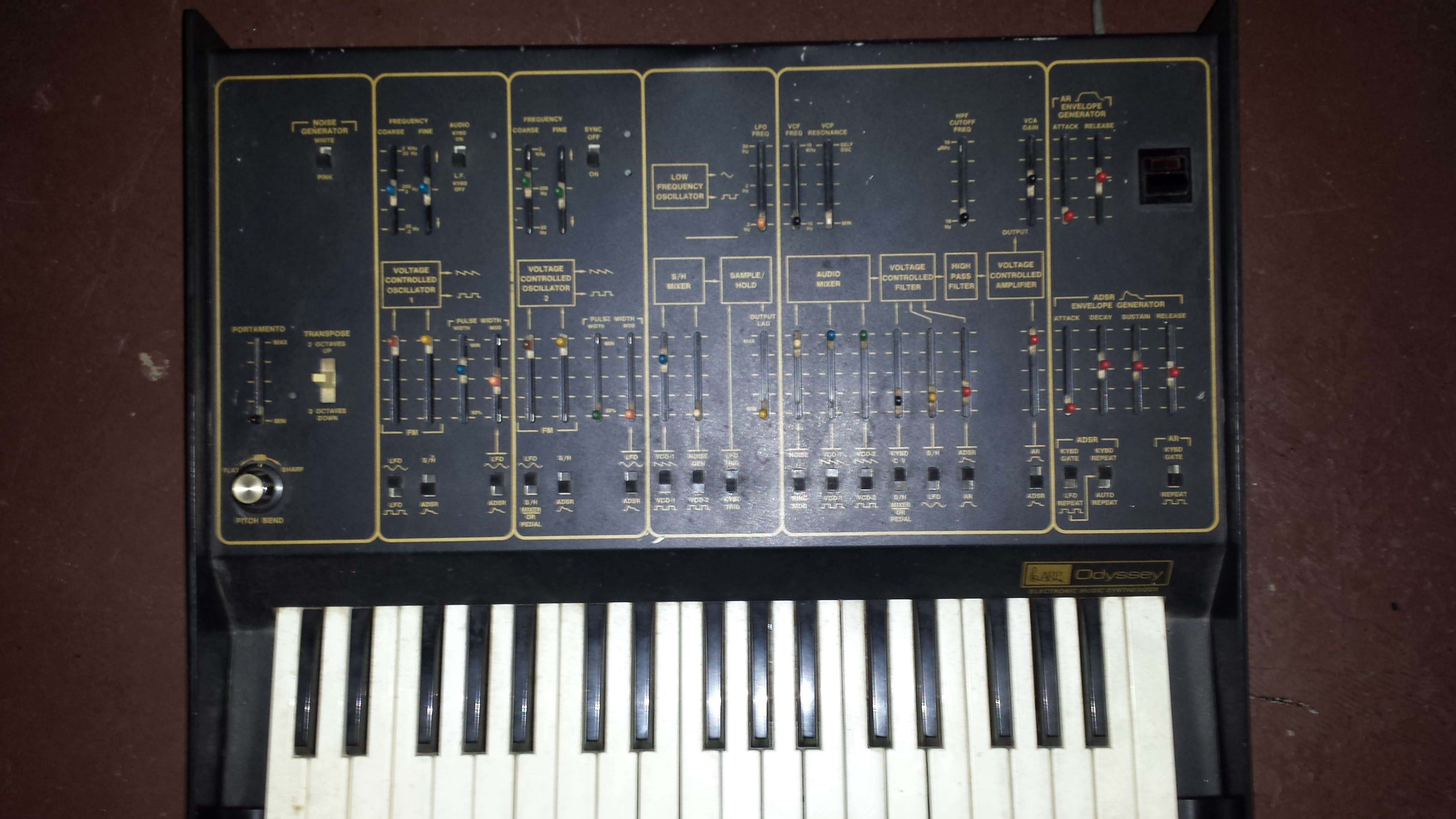
 20150215_172119 If you wanted an organ sound you carried around a Hammond or other organ.  If you wanted to use synthesizer sounds, you brought in a Moog or Arp and played two sounds at a time ……. and it felt glorious! 

Now you should have a comfortable of understanding – MIDI is a communication system between equipped devices.  This information allows us real-time control of receiving devices.  While there are a lot of basic on-off commends (actions) like note, sustain, start, stop, there are other commands that offer a range of control, typically 1 – 128 (or zero – 127).  Basic computer stuff, so we are stuck with a lot of groups dealing with 8, 16, 128.  You get used to it.  These continuous controller commands can be used to change how the receiving device or sound responds to the movement of the continuous controller. 

Here, I am not talking about the keyboard or sample trigger.  These are basically in-put hardware.  A few examples commonly found are modulation wheels, pitch bend wheels, joysticks, ribbons, foot controllers, and faders.  As mentioned earlier, you can send channel information to a number of receiving devices.  You can use the keyboard as you Master controller and assign one continuous controller to signal the light board to fade in or out and anywhere in-between.  In some set-ups you can use a sustain pedal connected to the Master Controller and when depressed, the light board receives the command (MIDI message) and the fog machine will be triggered.  Key pad triggers can be set up to do the same thing, but as you know, not every device is compatible with every other device, and sometimes features are left out from model to model.  But with most available manufacturer’s, you can easily accomplish versions of the above.

Performing in a duo band, my partner and I played guitars, I played keys, we both sang, he controlled a drum machine with bass pedals and I controlled a programmable drum machine.  As we did more popular dance style music, I would use the drum machine (sometimes when it was idle during a song and sometimes as another layer…) to sequence the synth-bass line of a cover tune.  Then I could play more keyboard parts live for a fuller sound.  As a songwriter, I have used this a bunch to create new audio landscapes and textures I probably would not have found on my own.  So try this if you have the necessary toys;

Take a drum machine or a MIDI drum pattern and play it over and over.  Now, change the sound of the MIDI receiving device or direct to another tone generator (yes!, for visual effects you can also do this to run lights if the sequence is done with the light board in mind).  But don’t just change to another drum or percussion patch.  Change it to a synth bass sound or orchestral strings – and keep changing.  Some sound settings you will not hear anything at all (probably because the drum notes are typically short in duration (and should be as we will get to later) and the sound has a slow attack and is not responding quickly enough to make the programmed tones audible.  (for this you can try holding down a sustain pedal if available and see how the sound responds to longer duration) I plan to go into the properties of ADSR in future series, so we will cover that in detail later.  Some sounds you will not hear every note from the drum pattern but as you listen to a wide variety of sounds, you will find this is OK. 

If needed, change the MIDI Note Number (oh, man, another topic!) from a crash or cowbell in the drum pattern and you can make it trigger another note that might be closer to the key or scale you are working in.  As you know, MIDI also provides real time control, so you can trigger other devices using this function during live performances and still keep it live.

Sound reinforcement can be broken up into simple segments and based on need of reinforcement project, we can narrow down the staggering options that can distract us.  Let’s dig in.

If you will only use pre-recorded music or audio tracks, this is relatively easy and you will get there quickly.  I will concentrate on the live performance for this series.  We will look at the needs of the band members, the requirements of the audio gear, understanding the environmental effects and the basic strategy to make it all work together.

Once you know the number of performers and the location of the event, you can begin planning on getting the gear you need and an idea of the requirements for great sounding – crowd pleasing live events.  The first step is to get an idea of the show/act/performance.  Live drums?  Keyboards or brass section?  Speech or information, you get the idea. 

Get an accurate count of the number of inputs you will need.  The total is important.  This can determine the size and capability of the mixer and the requirements of cabling, ‘monitors’, stands and microphones needed to cover the performance.  Then break them down into basic groups. 

Keep in mind that for making a live performance work, you need to have two totally independent sound systems available and in control so if we think about it, there is a sound system on the stage with the performers so they can hear themselves – and other performers – and any media they need to be aware of or perform with.  The audience requires the second system and this makes the party get started when the ‘house sound‘ gets cranked up and sounds great.

Most band /performer gear and audio cables will be connected to a long cable with a box at the end called a ‘snake‘.  Most inputs will be ‘mic‘ cables with three connectors for low ‘impedance‘ sources.  The microphone of your choice connects to a mic cable then gets plugged into this box on stage.  The snake connects that input to a very long cable leading up to the ‘mixing or sound board‘.  The sound board can listen separately to each input from the snake and can send that signal to a variety of ‘audio outs‘.  We will focus on the basic ones needed the vast majority of the time now and add more later on in this series.

The mixer – sound engineer will be able to send some of each performer’s input signal back through the snake to the amplifiers and their related on-stage speakers or in-ear monitors, etc.  (in this process it is really handy for the sound engineer to bring his/her own microphone….!!!!  That way once you turn on the stage monitors (on-stage speakers for performers) you can talk directly to anyone on stage and the main speakers going to the audience can be turned off so the audience will not hear you).  This allows you to quickly communicate to band members to help you sound check quickly.

The mixer – sound engineer will also send measured amounts of all performers’ inputs – all blended into a clear representation of the performance – to the main or house amplifiers and their related speakers/cabinets.  Effects like reverb and delay can be added to enhance the overall sound and ‘feel’ of the music/performance. 

That is the first goal.  Create two sound systems with the mixing board as the hub.  Operate them independently and you will be miles ahead of the rest of the ‘sound gurus’ I have heard out there.

My experience with music and performance is probably not unique.  Like a lot of people starting a craft or sport, learning to play an instrument or act, I just didn’t have a lot of confidence or even history to know how I was doing.  I mean, at this point I am not even asking ‘when will I be good enough to …).  Still fairly young at this point, I really like playing drums and percussion.  I tapped out rhythms everywhere I went.  We got a small organ for Christmas one year and I was drawn to it for months.  Harmonicas, a cheap guitar lead up to recording gear.

As I played instruments and fiddled around with lyrics or microphones and power amps over the years, I realized two things pretty quickly; 1) I knew and understood things a lot of people will never understand and 2) I knew a lot of really good players/musicians/artists, and they were much better than me.  I rationalized that I considered myself to be a songwriter (not even singer/songwriter early on) and that was good enough for me.

Today, I encourage each of you to think not just about the target or the goals in your musical performing careers, but to think about how you will continue to improve your craft.  Writing songs, performing someone else’s or running sound and making everyone sound great – each takes practice and effort.  But eventually it takes confidence.  Can you really do it.  What if you totally screw things up? What if they don’t applaud (or laugh or cheer)?

I spent quite a long time before I realized I had everyone else’s confidence BUT mine!  Knowing what I do now, I would have accepted a few more challenges.  I might have encouraged more projects.  I could have inspired someone else.  So now, let me inspire you.  Don’t wait until everyone in the universe thinks you are “good enough” to get out there and jump in.  At my job I tell trainees that I know as much as I do because I have made every mistake possible.  Do what you love.  Put your heart into it.  What if you screw things up?  You learn from it and the next time you do better.  Do it a bunch, and you will be great.

Happy Valentine’s Day!