I thought I would share this little piece with you. I am just experimenting with new sounds to see what I come up with. There is no real structure or drum tracks to speak of. Just a bunch of cool textures and visions of other worlds. Or, maybe it is this one in the future?
For a bit of prospect work, I wrote lyrics to an old 12 sting guitar jam of mine. I released ‘First Move’ as an instrumental track on my cd ‘Before The Chase‘ on February 25th, 2016.
(As a side note, one of the great cover/original bands I performed with live was ‘The Chase’. I also released a title called ‘After The Chase‘ in 2017. In both cases, auto-spelling correction wants to make the title : Before the Chase and After the Chase. Some on-line distributors would not accept the capitalized version in their listing. The reference to my former band mates does not jump out if it has a lower case ‘t’ for the. Now, back to my previous train of thought).
I really like the way the tempo and the groove combine to make an interesting driving-sports-workout jam. I use open tuning for the guitar, and that allows me to get those really clear harmonics to stand out. The lyrics reference the many people in my life that are truly amazing. Dedicated, hard working, dependable friends and strangers in the background making the world a better place for others. Doing the right thing – for no real reward and little recognition. Heroes are all around, they just don’t make that much noise.
Unlike other computers available at that time, it had built in MIDI ports! This allowed musicians to connect the computer to the new generation of MIDI keyboards, sequencers and drum machines. MIDI stands for Musical Instrument Digital Interface.
Later I got a job at a music store selling musical equipment and was given the nickname MIDIMIKE!
I still have the Atari and my Yamaha DX7 MIDI keyboard.
Thank you for the response to my mix of “The Dream” using Dolby Atmos. Not to geek out on you again, but this is something cool that you have probably already experienced and can relate to. Many of you are familiar with the amazing sound system upgrades in theaters and home audio during the last few years. Dolby has always been a big name in noise reduction and surround sound for movies and the like, but they have upped their game to take advantage of new tech and to deliver needed changes for next-gen venues or virtual reality applications going forward.
To make the explanation simple, we are all used to stereo sound with two speakers on opposite walls or using ear buds and headphones. A few decades ago the industry tried a quad system for the first try at a surround sound playback. Novel, but it went nowhere for a long time.
Your home surround sound or home theater system has been using multiple speakers for a while and added a sub woofer for the very low sounds – (sounds might not be the right word here. You feel the sub frequencies more than you hear it. This gives you the earthquake-like vibrations for sound effects).
Movies and other applications are using Dolby’s Atmos to reach the next experience level. Dolby Atmos provides programming to create a realistic 360 Atmosphere – as in SPHERE. Instead of two or four speakers and a subwoofer, there are countless individual out-puts for a large number of floor speakers that surround the listener(s) in a precise configuration. Then you add the sub-woofer as before but now we bring in speakers mounted in the ceiling (if room allows) or on stands close to the celing. Now, if they want to make it sound like some one is talking behind you, they play that sound through specific speakers in the back of the ‘listening room’. If there is a helicopter flying over head you are sure to look up expecting to see it there.
I have been using Presonus Studio One+ as my DAW or software recording system for a while. In their most recent update they included a version of Dolby Atmos. I don’t make action movie soundtracks, but the ability to use this tecnology to mix songs and bands gives us a whole new level of mixing.
Instead of placing the performer somewhere between the left and the right speaker as our only option, we can now make the sound feel like you are sitting ON the stage. You will be able to hear the drummer sitting on a riser ABOVE you in front, the guitar player on one side, the brass section on the other. As the singer walks around the ‘room’ they can literally walk behind you.
Now, if you are like me and don’t have a bunch of powered speakers and unlimited out-put ability …… you can get a lot of the effect using good headphones. The serious number crunching of the Atmos program gives you the illusion of three dimensional space in the headphones and for virtual reality sets.
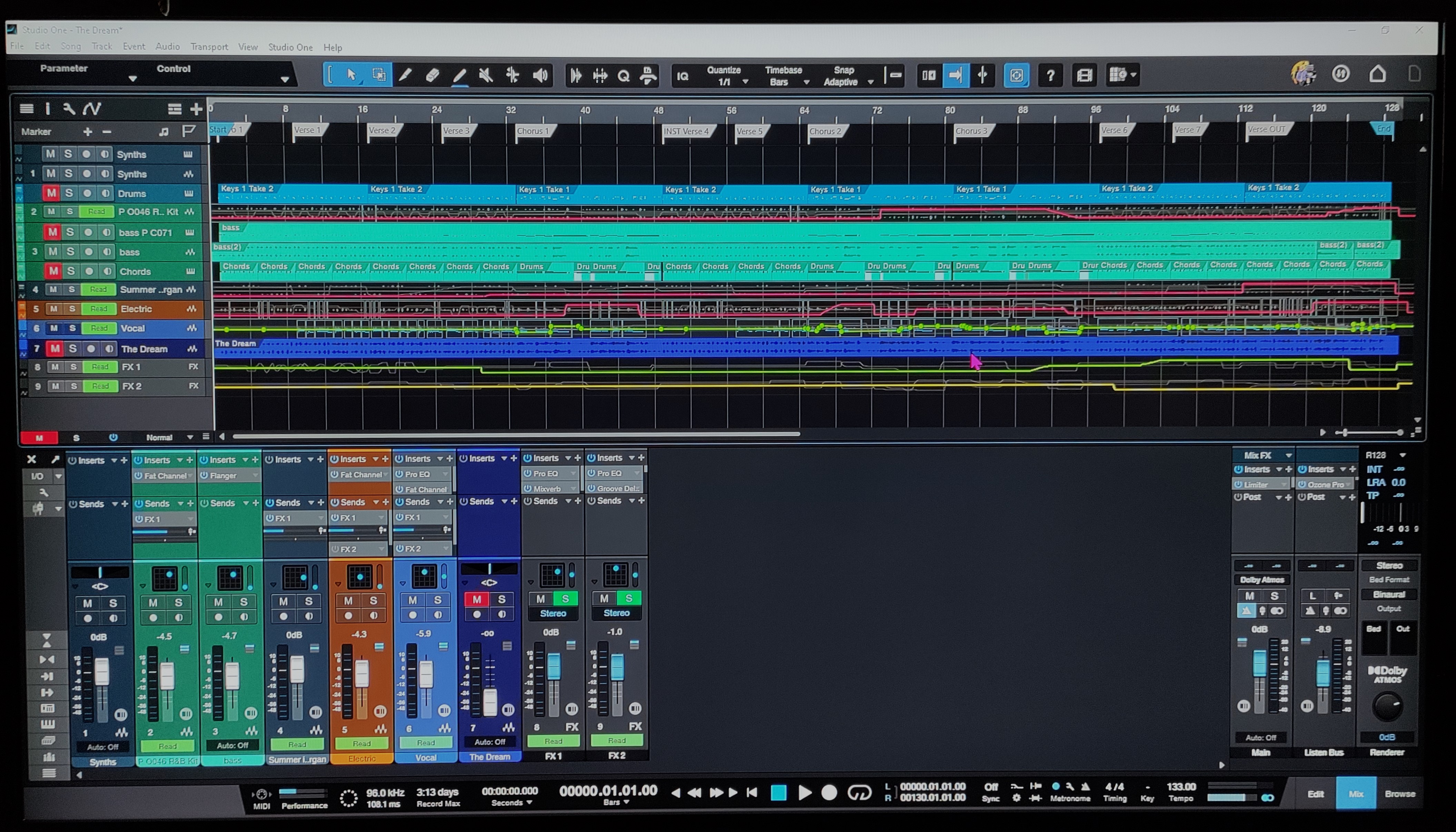
The above is a screen shot from a simple song I have written. It shows the different tracks below, and above panel shows the Spatial Panning data used on each track to give placement info to the speakers.
I will also post one of my songs below now, so you can hear a bit of what Atmos has to offer. Please keep in mind that using headphones is obviously a bit limited when it is compared to the massive speaker system in a theater, but, you will hear a difference. For music mixes, you may not hear a lot of movement. Try closing your eyes while listening through good headphones and with the speakers OFF. You will soon be able to point at where the performer or instrument is coming from – not just left or right – but literally point to it, up – down – left -right – in front and inside your head if desired lol.
….this screen gives you an idea of the ‘room interface’ you work in. Each dot represents a sound or instrument and can be sonicly ‘placed’ anywhere by moving the dot as needed.
Below is my Atmos mix of a new song I wrote and recorded, called “Still Your Choice”. I hope you get to hear the effects Atmos has to offer in this mix. While it may not be your type of music as I claim not to be commercial to begin with, the song shows how ‘open’ or deep a two track recording can be!
After smoothing out the timing and lyrics to match the mood I was after for this new song, I wrote a melody that seems to fit pretty well.
I squeezed some of the lyrics as I mentioned and cleaned up the instrumental glitches (a technical term for anything that isn’t right) and added a few parts to the instrumental verison I posted earlier.
Minor changes go on for a long time in the final tracking stage. A lot of it will not be used at all and some will be low in volume so as not to hear distinctly. But similar to color splashes added to the face in a painting, it can really bring out the rest of the ‘image’.
This is an early recording of a Cincinnati band “Chakras”. I recorded them back when I used the ADAT digital tape recorder. It does not have the ‘bling’ of modern recordings but I think you will enjoy the performance.
I would like to share another half-baked instrumental piece with you. When you have written over 175 songs you have to try very hard to discover new things. Sometimes we audio engineers can get stuck in a rut too. We use dependable tools and procedures until we slowly lock ourselves into a production-line-song making-engine.
If you are a label, publisher etc., you will appreciate the cookie-cutter assembly line model. You would benefit from the homogeneous funnel that affects all the broadcast music we listen to today. As you can tell from my previous posts, I choose not to be main stream and often try the unusual or untested. But this is where I will stop whining about a music industry that only wants to back the mega mega stars of today. Our favorite musicians from the past would never get a break in today’s world. Long live rock and roll.
This song is in the chopping block stage. For fun, I noodle with varied instruments all the time. Most of it is nonsensical and I archive or delete it. Often there are really good gems in a sea of debris. On occasion, most of what I created sounds good and for some reason I like it. There are parts that work well and others that need to be enhanced or deleted. The software is capable but fairly easy to edit and “copy – Paste”. If you like or dislike a section, please let me know the min/sec in your comments.
This recording was a little unusual in the process side of things. I started with a metronome click track in my computer. I picked up my guitar (always in tune) and set up the computer (always ready to record) and – I am being literal here – found a chord on the guitar. Without regard for key or scale or root, I just kept trying different positions until I liked the sound and voicing of the chord. I started recording just that chord in various styles for a few minutes. Each chord clean and distinct. Then I would play a pattern or arpeggio with the same voicing. Then a few hard hits. Next I stopped recording, found another chord and repeated that process.
Once I had a number of guitar parts that I liked, I arranged them along a measured grid to create a single guitar track. I used chords for different segments of the song to create the chorus and bridges. Once the guitar was assembled I listened to the guitar and recorded MIDI bass guitar, piano and drums using the plug-ins in my software (Cakewalk/Sonar/Bandlab). The drums have a jazzy dynamic feel and I like the way some of this song fits together. I imagine watching for the sunset or sunrise over the hill on a chilly but beautiful day. That’s just me.
I have to fix a lot of things and it is not complete as I cautioned, but I hope you like it. BTW, I call it “134” because that is the tempo! I really have to work on my naming skills.
In most situations when you want to record a performance, you might not have a lot of time to set up. The environment might not be perfect, and there are other needs than getting a great recording. I have tried and been quite successful with a number of techniques. I will offer a few here for your consideration.
Getting a good mix from the sound board Mono Out or Main Left and Right Outs in a small or medium size venue is very easy to set up, but most likely to be disappointing. The needs of the audience in a live situation can be the exact opposite from the recording engineer’s. As mentioned in the beginning of this series, LSR is reinforcement. The sound person will amplify the weaker signals in the House or Mains; vocals – along with a LOT of effects, acoustic guitars, flutes, and even the drums. They might not need to reinforce the lead or bass guitar as much. So the board mix is heavier on vocals, effects, and keyboard in some cases. Not a great listen for most people. You can set up a sub-mix if the sound guru gives you access. If they run Left (Mono) like most venues, you can create your own mix using the Right Mono out. Using the pan for each channel, keep full signal going to the Left out, and pan toward Center position to send desired amount of signal to the Right out. You might want to isolate the guitar or bass, add a little toms if they are mike’d, but not heavy in the mix. You can mix the two outs if you record in stereo and get a great live sound. This will not give you a perfect stereo field, but most audiences do not remember concerts in stereo. The sound seems to come from the stage, not left and right cabinets in front of the stage.
I have also had luck with those portable stereo digital recorders available now for what I think is really cheap for what they do. You need to set them up correctly and take care of them but they are so easy to set up and you get great sound in various environments. If you have a SAFE place where you will hear more of the band than the audience (sounds easier than it really is) this is worth a try.
While performing with my last cover band, Crash Landing, we played local clubs, festivals and private parties. In this picture of a live set up, you will see a fairly standard rock/blues/country/alternative/jazz band stage arrangement; drums center rear, Lead Vocalist center front. Keys (and/or rhythm guitar) on the left as you look at the stage and the lead guitar player on the right. In smaller clubs the keyboards get crunched back in the corner next to the drummer…… no sour grapes here! Bass player close to the drummer. (either side doesn’t really matter) In reality, most bands will not practice in this configuration, but this is the way most of us play out live and we are quite used to it. In our case, Crash Landing has a number of vocalists. All but the drummer sings in this band. The bass player takes front stage position and sings a number of lead vocals. So does the guitar player. You can see where the microphone stands are placed for the vocalists. Close up pictures later in this series will show other microphone positions for the instruments. These are good places to start. If you have limited time or setting up for a number of bands in an evening, you go with the standard format and shape the sound from the board as much as possible. Knowing or having experience doing the quick set-up successfully a few times you will see the standard configuration and mic placements work well for the vast majority of performances.
We can also see the positioning of the vocal stage monitors across the front of the stage. There are various thoughts on how to set these up but the differences can seem minor. For this many vocalists across the front, this spacing and direction worked fairly well. The drummer and/or other non-vocalists might also need monitors. (it would not be unusual for the keyboard player requiring a monitor to hear the keyboards and a vocal mix if they sing) This stage size gives players room to breath AND hear. When inside on a smaller stage, everything seems to collide and jumble. Outside you can hear yourself play much better (depending on the sound engineer, of course) and at times you might actually struggle just a little to hear the other players! Take two steps closer to them and they are plenty loud. This should be an easier situation for a sound engineer. If I had to do a first gig in my life as a practice run, I would want to do an outdoors gig.









 MidiMike