Again using Dolby Atmos for the spatial audio mix, I have another song for you to listen to. Using headphones will give you the best dimensional effect, though the speakers will also reflect some clarity and each instrument or vocalist will be heard a bit easier and clearer – more distinct.
I imagine this to be similar to being in a small crowded room with lots of people talking. It is hard to make out any of the conversations going on around you. Now, Imagine the room much bigger and everyone spaced further away from each other and you. Now you can hear conversations and know who is laughing or singing. Something like that. Instead of mixing so all the instruments are ‘sitting on top of each other’ in the stereo field, the listener can be part of – or completely removed from the sound scape. We can now give the listener the illusion of sound coming from anywhere in the ‘room’ we create.
Here is another song I wrote and recorded recently called “The Dream”. The spatial effects in Atmos do indeed, give a new dreamy sound to the mix.
For those of us that wear reading or corrective glasses, this will sound familiar. The other day I was thinking about the song mixing process. There is as much magic as there is science in the combination of so many different sounds and textures into a coherent musical landscape.
Audio engineers also discuss or rather joke about the Mastering Dilema: how the mix is never really done. There is always something you can do to improve it. (in reality, at some point all we are doing is changing it, not improving.)
If you ask 100 different studio masters to mix the same tracks, you will get 100 different mixes! The ingredients will be the same but the flavor can literally be worlds apart!
Which brought me rambling to the eye exam process. For those not too familiar, you will sit in a dark office looking at a small poster of random upper case letters on the other side of the room. The optician will ask you to read as many letters as you can, as they decrease in font size each row and become smaller and smaller.
Then they swing a large instrument in front of your face that allows them to place a specific corrective lens very close to one eye at a time, as the other eye is closed. Looking for different parameters, the optician will change the lens to a different prescription, then a different one, then to a slightly different one. Asking, ” Can you see better with One or Two?….. With Two or Three?…..With Three or Four?….”
This goes on and on with variations so slight at times you have to ask them to compare again, and often you aren’t sure you made the right choice! This is what mixing a song in the studio can be like. You make changes and minute corrections and aural enhancements that individually no one will hear. It is often necessary to make your mix sound the way you feel comfortable early in the session, and stop. Finish it. Finalize it. Put it away.
I put lyrics I posted earlier to a new piece I am working on. This song also originated as a mathematical idea. Based on rhythm or patterns this time. Specifically: drumming my fingers on the top of a dinner table. Percussion is so deep in my history it is hard to separate it from the real world. So I tap out a rhythm that is slightly difficult until I get it consistent. This drum pattern is short and repeated with slight variations over time. As you might imagine from listening to music, even drums are ‘tuned’ for specific songs or projects.
Each tom in the drum kit is tuned to a specific pitch (the good drum techs will match the tuning to the current song/project/session). Now transfer those notes to a piano staff and you can play ‘melodies’ on the drums. My finger tapping pattern became the basis for an arpeggio of sorts when I used it to play different chord formations on my Korg Nautilus keyboard. That meant that I would use the repeated pattern for each chord in the song progression. Then I added new parts and changed a bunch of stuff until presto-chango! A new song!
I got out my cheapo 5 string bass guitar and added a back up feel for the keyboard melody. I like to add guitars to most of my recordings and used my brother’s Martin 6 string to add the chord structure and main rhythms throughout the song.
Once the arrangement was settled for the most part I started to write the drums. This gives me the opportunity to match or follow the accents and rests in the guitar parts. I can make sure the drum beat is matching my song and not the other way around. I often add rhythmic nuances to each verse and chorus. I use a MIDI drum pad to trigger sounds in software I have in my recording suite and created each segment’s drum track. After way-too-much-editing, I got a reasonable drum track with good balance and lively feel.
You guessed it. I do all of this myself so now it is time to come up with a melody and try to do the best I can to sing it. Most often the melodies I write reflect my limited vocal range and power. I would have a real vocalist sing what they were able to and felt inspired to sing. Same with all the other instruments I play as well. I get out my Audio Technica 4033 microphone to work out melody, timing, phrasing and harmonies. It takes me a number of practices just to find where my voice can fit in and what notes I can (and can’t) reach. All prepared and organized it still takes me an hour or so of trial and error to record what you will hear even though it is not quite right.
Package it all up with solid mixing levels and some processing or effects added to individual tracks and I have a quick mix ready for you. I might not add anything else to this song personally. As usual, I will play this song for friends and see if they feel like adding to or replacing my tracks.
There are so many ways to create music. Take your MIDI melody line and make it the bass guitar part. Use any drum pattern to trigger piano notes or other samples. Play with the rhythm by starting the drum pattern on beat 2. Listen to birds chirping or wind chimes in the breeze. Make it easy to get started and see where things go, but rule number one: don’t wait for the vocalist to show up!
I mentioned before that one of the more painful things about getting old is inheriting stuff from your friends that are either no longer able to access older technology or loved ones that checked out of life before you do.
Recently, many wonderful musical things of no real value have found a home in my house. Some make noise, some record noise, some avoid noise, but all have been turned into music by friends of mine for decades. The memories and cave-man-level responses to sounds from the past hits me hard. You probably grew up hearing these sounds, but you might have been in the womb or soon after to this world when hearing them. These toys literally created most of the pop – rock and country music you grew up to. The list is too long for TV and commercial applications.
Anyway, unless you know what this stuff is (and things weren’t small in those days) and how to make it work it might as well be a pyramid that becomes nothing a storage problem. As usual, I digress.
Recently, I was given half a ton of old 45 rpm vinyl records.
But not the ones you buy at a store. To avoid another really interesting connected tangent, I will simply say that these came from a company where my wife worked. It was one company and then absorbed then another company and Clear Channel picked them up when their critical mass became too big to ignore. I apologize for the brevity, as most people won’t be interested, but they conducted surveys for radio stations across the US.
They condensed the song – ALL of the songs you would likely hear on commercial radio decades ago – to a 5 or 10 second “hook“. Whatever it was that identified the song to listeners was the hook. They conducted thousands of live – in – person paid surveys across the country to get listener’s opinions of the NEW artist or POTENTIAL new hit. These are not for sale and not available at the stores. My people know I can still use vinyl and other technologies but more importantly I can take care of them.
This brings me to another tangent I cannot avoid. So many of the treasures I have been given are no longer operable or salvageable. A little more thought in storage would have turned so many of these treasures into true gems. Rust, mold, misuse – no use, all take their toll. My stuff still works. From the time I was in high school forward. I bought good equipment and accessories and I took care of them because I knew I could not afford to replace them.
I finally get to the point to this post. I have hundreds of records. My wife worked for years watching literally thousands of bands and their best efforts to make it big. Yes, I heard many of those as well. Some were interesting, some were cool and most were painful. But the thing I am getting to after listening to each 45 record after the other is a simple but powerful message if you are trying to ‘get a deal’: Don’t spend all your energy creating the GREAT HOOK. I hear failure after failure after failure trying to be something you are not. Maybe you have to be cute or edgy to get noticed. Just make it your own edge.
ANY of these bands produced records and demo’s that are much better than my in-home singer/songwriter efforts. They have money and backers and investors looking for the next best thing. But the great hooks are organic and time-locked so you are chasing a dream. So much potential dedicated to making your band sound like someone or something else already out there. Tofit the cookie-cutter rather than make the cookie shape. It could be said I make the cookie shape and I am not famous. Mine is not a formula for success.
There are famous artists in this small collection so many do succeed, though I see so many failures because they are trying to find the magic lamp. Stop looking for it and create one for yourself. If it was that easy I would not be sitting here, lol. In the future I will share some of these records. They are not for sale, but I am not sure that means they are not for share.
Here is a record by Gipsy Kings I thought was pretty cool.
I posted a poem earlier called “Let You Go” https://midimike.com/2020/07/07/let-you-go/ that I really liked. While I was working on writing the music for these lyrics I got side-tracked. I had recorded a few MIDI drum parts and had a guitar theme I liked playing on my Martin Acoustic/Electric guitar chained together trying to get a feel for the song.
A good friend called me out of the blue and asked if I wanted to have his old MIDI studio gear. No instruments or toys will be orphaned if I can help it so I drove over that day. We chatted for a while and I left with a van full of what most people would call ‘ancient’ gear. This is the stuff hits were made with. Everything you heard growing up using electronic drums or synths used these gems.
I got home and hooked up a few pieces like a kid not knowing which present he wants to open first. DAYS LATER I opened up my recording project again and played with a vocal effect toy I had not gotten to yet. Not wanting to stop an idea I was working on I started recording in another section of the session. As you will hear, I decided not to sing the chorus parts. Instead I used some of the lyrics to do a chant-style intro and outro.
After juggling the original music around I started to work on a melody for the lyrics. I used some of the chant themes so the melody took shape pretty quickly. Not wanting to overdo the vocal effect, I just used reverb on my voice. Then I added some MIDI bass guitar sounds and put the pieces together.
Next, I added a little MIDI piano in the chorus sections and sprinkled through the end of the song. Then I made some stupid editing error and trashed all of the drum tracks!!! Redo the drum tracks and a few days later I have a rough mix for you.
As some of you will know, a rough mix is probably the last one I do! LOL.
Here is “Let You Go” as it stands today. I hope you enjoy this one.
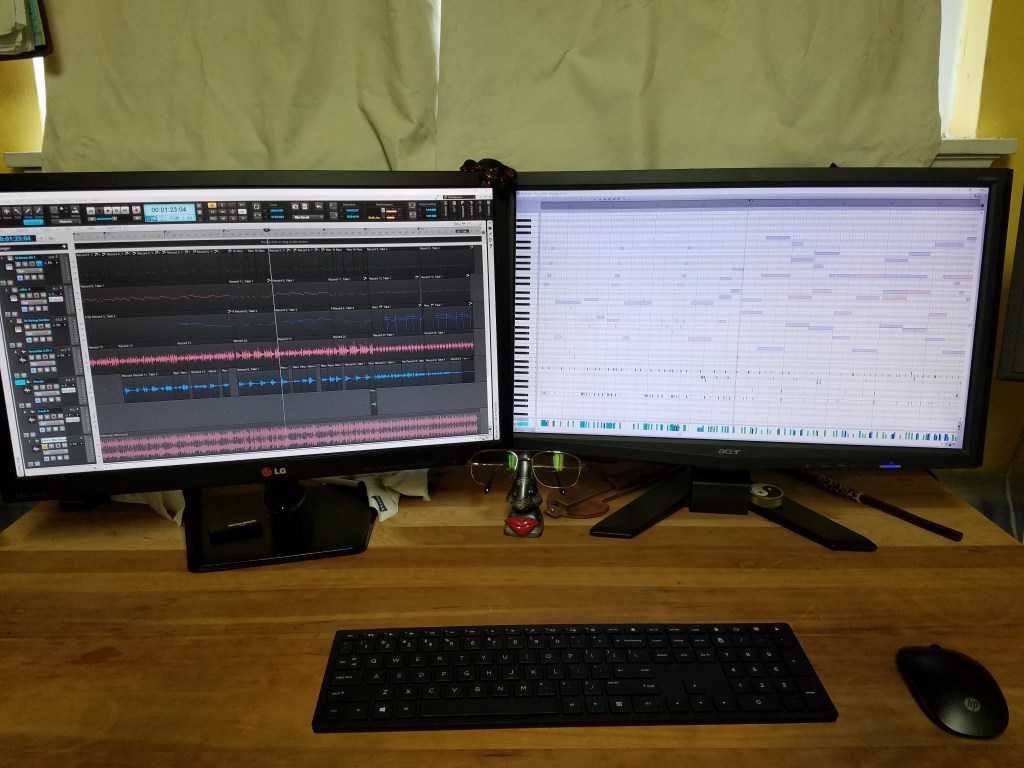
Sonar Track Panel Wave and MIDI files that generate sounds from computer programs called plug-ins
I mentioned experimenting with an on-line jamming program. It became the clipboard for a few guitar sections I created while waiting for one thing or another to work. I titled each as verse, bridge, chorus, etc. I had to give it a project name to save the clipboard and I came up with “Not Now”.
I used those short pieces and assembled them into a song arrangement. Once the chords and arrangement were in place I naturally started thinking of lyrics (as I have a tendency to do). The file was named Not Now so I kept it as my Cakewalk (BandLab) project name. So it becomes the theme of the lyrics. In one hour they were written. Getting them to match the odd rhythms and sparse instrumentation became a challenge. It took me a few days to come up with the melody and then practice it enough to get the rough tracks down. To all just joining; I get things down to rough tracks and then write another song, poetry, lyric or instrumental. When I was young I hoped some band would do my songs correctly in a studio. I am not young now.
Here is a rough mix of “Not Now”. I used a Martin Acoustic/Electric guitar for the guitar track. Using my MIDI keyboard I pulled up a plug-in for drum sounds. I imported the original noodling guitar parts I did from the clipboard but they were not recorded to a metronome or drum pattern. I listened and figured out the tempo of the segments and set Cakewalk to match. That way I could listen to the short guitar segments as I created the basic drum parts and arranged all the segments in order. I pulled up a bass guitar sound and played the MIDI keyboard to generate the bass line.
Next, I Muted the original guitar tracks and recorded a new track to replace it. The song seemed to cry out for strings but that is usually just me. I like good sounding strings in various styles of music.
I use two monitors as there is a lot of information to keep ‘track’ of even for a small project.This is the Piano Roll view. Each color represents different instruments. The lower group triggers drum sounds.
I gave a link to BandLab above. Full disclaimer this is not a commercial and I do not get paid for anything I do here. However….. if you are interested I used to pay hundreds of dollars every year or so to keep this great recording program updated. They now offer the program and all updates for FREE. No kidding.
I hope you enjoy “Not Now”. Each time I listen to it I like it more. Again, this is just me as each new song I write becomes my newest favorite.
The lyrics for “The Border” were posted earlier. There is also a little story to this song using the link above.
…….. for the nerds and geeks in the audience, I created the song in Bandlab’s Sonar (formerly Cakewalk Sonar). This is not a commercial but if you are interested in recording, podcasts, audio to video and a bunch more, BandLab bought Sonar out of bankruptcy and is making this program free to download and use!!! Argh! I paid hundreds of dollars each year to keep current and have new toys.
I am not against commercials or someone making a bit of money but there really is no connection here. If you want to download Sonar, search for BandLab and hit the download button. It is a powerful multi-track recording program with sounds and plug-ins ready to use. I could give you the link but that would seem like I am pushing it lol!
Most of the connectors used for outputs will be 1/4″ male jacks. These can be for ‘grounded’ (three-wire) or two-wire cables. To make this part confusing, the cables can be made or changed with adapters to almost any connector type. For long distances we prefer grounded or three conductor-wire cables as the third wire is used to take common signals from the other two wires, and ‘dump them to ground’. Common signals would be interference and noise as the plus and negative wires are carrying the signal from the board. The result is good signal with low noise introduced. Guitar and keyboard cables typically go shorter distances and typically have a higher or stronger output signal than a microphone for example. The cables in the snake will use three wire grounded shielded cables even if they are 1/4″ male connectors.
So we might expect to have an XLR connector for the Main Outs to the Main House power amps, but this is not a guarantee. If 1/4″ jacks are provided it is recommended to use grounded three wire cables.
Most cables will provide a male connector on one end and a similar but female connector on the other end. Male connectors are often used to connect to In-Puts and Female connectors are often used to connect to the Out-Put. The male connector of the microphone cable connects to the mixing board In-Put and on the other end the female connector will connect to the microphone out. Generally speaking there is little advantage plugging an in to an in or an out to another out. I like to state the obvious LOL!
The mixing board will give us a Main Left and Right out, and probably a Mono Main Out. These will be connected to the Main or House power amps. During an event, the amps are usually turned all the way up and the House volume is ultimately controlled by the Main L-R faders on the mixing board. This is why it is important to turn the Master Volume Faders on the mixing board all the way down whenever connecting or disconnecting equipment or making dramatic changes.
Depending on the board size and configuration you may also have a 1/4″ Direct-Out for many if not all input channels. (this is REALLY cool for recording and a lot of other creative uses…) These can be really handy for independent channel recording, triggers, audio effects and alternate mixes to name a few. Basically connect these to external recorder, processor or triggering gear as needed. I will give some examples as the series expands to other main topics. You will also have a number of Sends that are used for a variety of tasks and have different names, but with a few configuration details are for the most part the same thing. Effect Sends, Monitor Sends, Auxiliary Sends, Sub Sends are splitters; they split the signal – keeping the one going to the House or recorder – and allowing you to send a lot or a little of that signal to the Send of your choice using the Send knob. As in the Monitor amps and House amps, the volume knob will ultimately be used to send the proper signal level to the external (and internal) devices or effects. If you ‘send’ this to a digital delay, it may also have its own input and out put level knobs.
You may also have a two-track input and/or out put. This is for playing stereo audio devices and for a straight stereo record out option. Handy to listen to practice tapes, intermission music, PA system tests and other performance related media.
For me, sequencing is fun and very versatile. I am not the kind of keyboard player that can jump in on any song and just start jamming. I do better if I can take my time and learn, practice, and improve before practicing with a full band. A lot of this might be from the lack of confidence in the early days, but in reality I find myself a jack of all trades and master of none. If I had spent more time on any one instrument, I might have gotten pretty good. Fortunately – or unfortunately, I have always been interested in so many different things that my chops were not the best. As a percussionist, I was able to hear what I wanted, but did not play drum kits so my feet and hands were always locked in perfect step! Sequencing gave me the ability to lay down rough performances on the keyboard (and remember I use the keyboard keys to ‘trigger’ the drum sounds, so I am still playing keys). Once recorded using MIDI – again I am not recording the sounds but the physical action and movements, I could enter the Edit Mode on the sequencer and make corrections to timing, notes, durations etc. until the piece felt good to me. For the drums, the standard practice is to use the Quantizing feature (I can go into this later as well for future posts) to make sure all beats were perfectly ‘on the grid’. I have used drum machines and sequencers since they first came out. The sounds are great but too often the result of overusing the quantize feature makes the drum tracks sound mechanical – unmoving – and even impossible for a real drummer. I preferred to leave a little slop here and there. I want emotion in my songs, not perfection.
In “Bassics”, I just enjoyed the new sounds I had and played with this Bass Guitar patch and came up with the basic groove. I like adding textures and unusual percussion/FX sounds to keep the songs flowing and changing. Available sounds are so much better now, but I still enjoy bringing out these old tunes.
The sound board or audio mixer represents the hub in most audio mixing and mastering functions. everything connects to the board. Even the lighting system will use channels in the snake to connect from stage to console. Things get plugged into and things get plugged out of the mixer as needed. Today’s mixers are blue tooth USB WiFi fire-wired and light-piped together and will connect to an amazing array of devices. So far we have focused on what gets plugged to the Inputs of the sound board. There are a number of connection possibilities for the Outputs as well. We have already discussed some of them earlier, so this can be brief as you already know a lot of this in general.
On most sound boards you have a number of analog-out options. In earlier discussions we talked about XLR and 1/4″ cables and connectors. These will continue to be the main ones used for outputs. On the front or face of most mixing boards you will see a stereo headphone out. It will usually have its own volume knob and probably a selector to pick the options to Monitor including Stereo Out, Solo, Effects Sends, Effects Returns, Sub or Groups, Auxiliary Returns, and other options. On the back or the top of the mixing board you will see the panel for Out-put connections in different sections. There are some rules to determine what type of Audio Cable is used and whether it is a male end or female end and whether it has two connectors or three (or more).
In the early days of mixing boards, microphones and keyboards, it was important which brand you purchased. If you wanted to get ‘that sound’ you had to have this mixing board channel strip or that particular keyboard. Later on the computer industry similarly shot through their early days and you had the Macintosh or the Windows PC. If you were brought up with one you could not be talked into the other. Most modern equipment from PC’s to Automobiles can do everything. They all have similar platforms and emulators. There is style and quality as there always will be, but you can get software mixing programs and microphone/guitar emulator plugins that will make your audio tracks sound like anything you want —-THEY CAN EVEN MAKE YOU SOUND LIKE YOU ARE SINGING IN TUNE!!
So if you like Pepsi, no problem. Want Coke? Press this button…… More comfortable using a Mac? Go for it.
All it takes is cash, a thorough understanding of what all the terms mean and a good idea where all the buttons are?!!?



 MidiMike